
How to Spot Fake Cricket Equipment: A Simple Guide for Everyone
Fake cricket equipment is a genuine problem in Pakistan and across cricket markets worldwide. Counterfeit bats, balls, helmets, and protective gear are widely available, and they are often difficult to distinguish from the real thing at first glance. The risk is not just financial. Fake protective gear can fail at the exact moment it matters most, leaving players exposed to serious injury on the field.
This guide covers the key signs to look for across every major category of cricket equipment, along with practical tests you can do before buying. Whether you are shopping in a store or online, these checks will help you make a more confident and safer purchase.
Why Fake Cricket Gear Is a Serious Issue
The appeal of fake cricket equipment is straightforward: it looks similar to genuine gear and costs significantly less. For a buyer on a budget, the price difference can seem worth the risk. In reality, the materials used in counterfeit equipment are chosen to reduce cost, not to perform or protect.
A fake cricket bat will not perform like a genuine willow bat. A counterfeit helmet may look structurally sound but fail to absorb impact the way a certified helmet is designed to. Fake pads and gloves use inferior foam and stitching that compresses or tears far earlier than original equipment. None of these failures is visible to the buyer before purchase, which is exactly why knowing what to look for matters.
How to Spot a Fake Cricket Bat
The cricket bat is the most commonly counterfeited piece of equipment. Fake bats are produced in large volumes because the price gap between a genuine willow bat and a cheap replica is significant enough to attract buyers who do not know what to look for.
Check the Price Against Market Rate
If a bat is priced significantly below the standard market rate for that brand or willow grade, treat it as a warning sign. Genuine cricket bats from established manufacturers carry a price that reflects the cost of quality wood, skilled craftsmanship, and proper quality control. A bat that appears to offer the same specifications at half the price is almost always built from inferior materials.
Examine the Grain Pattern
Real English willow bats have straight, natural grain lines running vertically along the face of the blade. These grains are embedded in the wood itself. Fake bats sometimes have painted grain lines to imitate the appearance of willow. To test this, hold the bat at an angle under a light or use a flashlight across the face. Painted grains reflect unnaturally and sit on the surface rather than within it. Genuine willow grains have depth and variation.
Tap the Blade and Listen
This is one of the most reliable physical tests available. Pick up the bat and tap the blade lightly with a cricket ball or your knuckle. A genuine willow bat produces a clean, crisp response. A fake bat made from inferior wood produces a dull, flat thud. The difference is clear once you have heard both.
Check the Weight and Balance
Fake bats are often noticeably heavier or lighter than stated because counterfeit manufacturers do not maintain precise weight standards. Hold the bat in playing position and assess the pickup. A genuine bat feels balanced and natural in the hands. If the bat feels dead, top-heavy, or unusually light for its stated weight, question its authenticity.
Inspect the Branding and Stickers
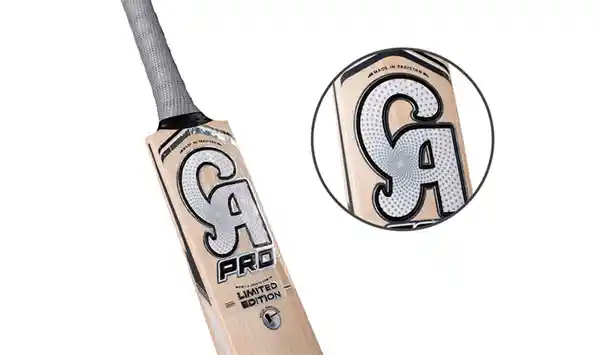
Look closely at the logo placement, font, and sticker quality. Genuine manufacturers apply branding with precision and consistency. Fake products often have logos that are slightly blurred, poorly positioned, or printed on stickers that peel at the edges. Also, check the spelling of the brand name. Misspelled brand names on stickers or packaging are a direct indicator of counterfeit production.
[Shop genuine CA Sports cricket bats]
How to Identify a Fake Cricket Ball
Cricket balls are among the most frequently copied items in the sport. The difference between a genuine leather ball and a fake is usually apparent once you know what to examine.
Examine the Stitching
On a genuine cricket ball, the seam stitching is even, tight, and consistent all the way around. The number of stitching rows and the height of the seam are manufactured to a standard. Fake balls have uneven stitching, loose threads, and a seam that may be irregular in height or alignment. Run your finger along the seam. It should feel firm and uniform.
Check the Leather Quality
Genuine cricket balls are made from quality leather that feels smooth and has a consistent finish across both hemispheres. Fake balls are often made from synthetic or low-grade material that feels rough, plastic-like, or uneven in texture. The colour on a fake ball may also appear inconsistent or fade quickly after minimal use.
Test the Weight and Bounce
A regulation cricket ball has a defined weight range. Fake balls are frequently outside this range because manufacturers do not apply consistent standards. If possible, bounce the ball on a hard surface and observe the response. A genuine ball has a predictable, lively bounce. A fake ball often bounces inconsistently or feels dead on impact.
[Shop CA Sports cricket balls]
How to Spot a Fake Cricket Helmet
A fake cricket helmet is the most dangerous counterfeit product in the sport. It looks protective, but is not built to withstand real impact. Buying a fake helmet is not a financial risk. It is a safety risk.
Look for Certification Markings
Genuine cricket helmets carry safety certification markings. Check the inside of the helmet shell and the packaging for visible certification labels. These should be clearly printed and not easily removable. If a helmet has no certification information, or if the markings look printed rather than embossed or permanently applied, do not purchase it.
Check the Shell Material
Press lightly on the outer shell of the helmet. Genuine helmets are made from materials designed to absorb and distribute impact. A fake helmet shell often feels thin, brittle, or flexes under minimal pressure. The shell should feel solid and consistent in thickness across its entire surface.
Inspect the Grille and Padding
On a genuine helmet, the grille is welded or secured with precision and does not flex or rattle when handled. The internal padding is dense, well-fitted, and covers all contact areas evenly. Fake helmets often have loose grilles, thin padding that compresses easily, and inner foam that does not spring back after pressure. These are not cosmetic issues. They directly affect how much protection the helmet provides.
Verify the Packaging
Original cricket helmets come in branded packaging with complete product information, size labelling, and manufacturer details. If a helmet arrives with generic or minimal packaging, no brand information, and no documentation, treat it as a red flag.
[Shop CA Sports Cricket Helmets]
How to Check Fake Cricket Pads and Gloves
Material and Foam Quality
Genuine batting pads and gloves use high-density foam that absorbs impact effectively. Press the padding firmly with your thumb. On a genuine pad, the foam resists compression and returns to its original shape. Fake pads use low-density foam that collapses easily and does not recover. This means the pad provides less protection on every delivery faced, not just in extreme situations.
Stitching and Construction
Examine the stitching on both pads and gloves closely. On genuine equipment, stitching is even, tight, and runs cleanly along every seam. Fake equipment has loose threads, uneven seam lines, and joins that separate under moderate pressure. Check the velcro straps on pads. On genuine equipment, they are firmly attached and grip strongly. On fake pads, the velcro is often thin and loses grip quickly.
Brand Tags and Labelling
Genuine pads and gloves carry clear brand labels, barcodes, and size markings sewn or printed onto the equipment. These should be consistent in font and placement. Fake equipment either lacks these entirely or has tags that are poorly attached, misprinted, or inconsistent with the official brand appearance.
[Shop CA Sports Protection Gear]
Verify Authenticity Using the CA Sports QR Code
CA Sports includes a QR code on its products as an official authenticity verification system. If you have purchased a CA Sports product or are considering buying one, scan the QR code using any smartphone camera or QR scanner. The scan will confirm whether the product is genuine and manufactured by CA Sports.
If a product being sold as CA Sports does not have a QR code, or if the QR code does not verify correctly, do not proceed with the purchase. This is the most direct way to confirm you are buying an original CA Sports product.
Where You Buy Matters as Much as What You Buy
The safest way to avoid fake cricket equipment is to buy from the manufacturer directly or from verified authorized sellers. Unofficial online marketplaces, social media sellers offering steep discounts, and unknown street vendors carry the highest risk of counterfeit products.
- Always buy from the official brand website or an authorized retailer
- Ask for a receipt and warranty at the point of purchase
- Be cautious of prices that are significantly below the standard market rate
- Avoid sellers who cannot confirm the product origin or provide documentation
- Never pay using untraceable methods such as informal transfers with no buyer protection
For CA Sports products, the safest purchase is always directly through thecasports.com, where every product is shipped from the manufacturer in Sialkot, Pakistan, and backed by a manufacturer's warranty.
[INTERNAL LINK: Shop all genuine CA Sports cricket gear > Homepage]
Frequently Asked Questions
How can I tell if a cricket bat is fake?
Check the grain pattern by holding the blade up to the light. Genuine willow has natural, embedded grains. Tap the blade with a ball or knuckle. A real bat produces a clean sound. Inspect the branding for consistent fonts, clean sticker edges, and correct spelling. Compare the price to the standard market rate for that brand.
What are the dangers of using fake cricket protective gear?
Fake helmets, pads, and gloves are built from inferior materials that do not absorb or distribute impact the way genuine equipment does. A counterfeit helmet may look intact but fail to protect against a direct blow. Fake pads use thin foam that collapses on impact. The safety risk is real and applies to players at every level.
How do I verify if a CA Sports product is genuine?
CA Sports products include a QR code that can be scanned with any smartphone. The scan confirms whether the product is original and manufactured by CA Sports. If a product does not have a QR code or the scan does not verify, it should not be trusted as genuine.
Is it safe to buy cricket equipment from online marketplaces?
It depends on the seller. Buying from the official brand website or a verified authorised retailer is always the safest option. Unknown marketplace sellers, social media vendors, and accounts offering unusually large discounts carry a higher risk of selling counterfeit products.
What should I check on a cricket ball to confirm it is genuine?
Examine the seam stitching for evenness and consistency. Check the leather surface for a smooth, uniform finish. Test the weight and bounce against what you would expect from a regulation ball. Fake balls often have rough surfaces, uneven seams, and inconsistent bounce.

Learn simple tips to spot fake cricket equipment and ensure you're buying genuine gear for better performance and safety on the field.
Recent Blog
29 Jun 2026
4 Most Important Items To Keep In Your Cricket Kit Bag
27 Jun 2026
How to Choose the Right Cricket Ball for Practice and Match Play
23 May 2026
What is the Price of Cricket Pads in Pakistan 2026 – Complete Guide
22 May 2026
Cricket Kit Price in Pakistan 2026 | Types & Buying Guide
19 May 2026
Who Scored the Most Runs in PSL 2026? Babar Azam Tops the List
29 Apr 2026
CA Cricket Bat Price in Pakistan 2026 – Which One Should You Buy

29 Apr 2026
Hardball Bat Price in Pakistan 2026 – Latest Market Rates
28 Mar 2026
Cricket Shoes Price in Pakistan – Latest Guide for Players
 Multikart Angular
 Multikart React
 Multikart Shopify